
How to Prove Your Identity When Claiming Unclaimed Property
Claiming unclaimed property through your state’s official program is a straightforward process, but it does require you to verify who you are before any funds are released — and that step stops many people in their tracks. States hold billions of dollars in unclaimed accounts, forgotten refunds, and dormant assets, and they take the identity verification requirement seriously to make sure money reaches its rightful owner rather than someone else. Understanding exactly what documentation is needed, why it is required, and how to prepare it properly can be the difference between a smooth claim and an unnecessary delay. This guide walks you through every aspect of the identity verification process so you feel confident and prepared before you begin.
What Identity Verification Means in the Context of Unclaimed Property
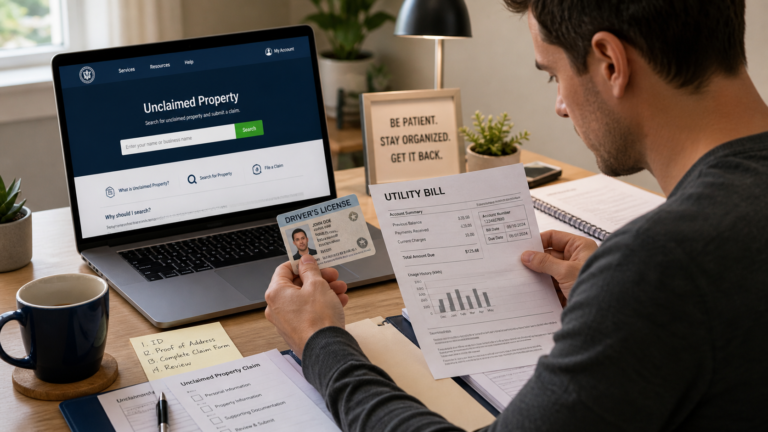
Identity verification in unclaimed property claims is the process by which you demonstrate to your state’s unclaimed property office that you are the same person named on the dormant account or asset being held. States do not simply hand over money because someone submits a request — they are legally obligated to confirm that the claimant has a legitimate connection to the property before releasing it.
This confirmation typically involves submitting official documents that establish your legal name, your current address, and in some cases your connection to a specific time period or former address. It is important to understand that this is not a credit check, a background investigation, or a form of financial qualification. It is purely a matter of confirming your identity matches the records attached to the unclaimed property.
The process varies somewhat by state, but the underlying principle is the same everywhere: the state is acting as a neutral custodian of the funds, and it needs reasonable proof before transferring them to you. Knowing this helps frame the documentation requirement as a protective measure for you — not a barrier designed to make claiming harder.
This confirmation typically involves submitting official documents that establish your legal name, your current address, and in some cases your connection to a specific time period or former address. It is important to understand that this is not a credit check, a background investigation, or a form of financial qualification. It is purely a matter of confirming your identity matches the records attached to the unclaimed property.
The process varies somewhat by state, but the underlying principle is the same everywhere: the state is acting as a neutral custodian of the funds, and it needs reasonable proof before transferring them to you. Knowing this helps frame the documentation requirement as a protective measure for you — not a barrier designed to make claiming harder.
Why Identity Verification Is Required and Where People Run Into Trouble
Unclaimed property ends up in state custody for a wide range of reasons, and the identity verification step exists in part because the original account records may be years or even decades old. A bank account that went dormant in 2001 may have been linked to an address you moved away from long ago, a maiden name you no longer use, or even a slightly misspelled version of your name entered by a clerk at the time. When the name and details on your current ID do not perfectly match what the state has on file, you may need to provide additional documentation to bridge that gap.
Common situations where identity verification becomes more complicated include:
The most important thing to know is that states encounter these scenarios regularly, and their unclaimed property offices are accustomed to working through them. The process is not adversarial — it is administrative. Having a clear picture of your situation before you begin will help you gather the right documents the first time and avoid back-and-forth delays.
Common situations where identity verification becomes more complicated include:
- Name changes — through marriage, divorce, or legal name change — where your current ID does not match the name on the original account
- Former addresses — where the property was linked to a home you lived in years ago and no longer have utility bills for
- Abbreviated or variant name spellings — for example, “Bob” on the account versus “Robert” on your driver’s license
- Accounts tied to a deceased relative — where you are claiming as an heir and must establish both your own identity and your legal relationship to the original owner
- Business accounts or professional licenses — where the property was held in the name of a company or entity rather than an individual
The most important thing to know is that states encounter these scenarios regularly, and their unclaimed property offices are accustomed to working through them. The process is not adversarial — it is administrative. Having a clear picture of your situation before you begin will help you gather the right documents the first time and avoid back-and-forth delays.
How to Gather and Submit Identity Documents for an Unclaimed Property Claim
Step 1: Search the Official State Unclaimed Property Database
Before you gather any documents, confirm that a property record actually exists in your name through your state’s official unclaimed property program. Every state maintains its own database, accessible at no cost through the state government’s official website. Search using your full legal name and any former names you may have used, as well as any former addresses. Note the exact name as it appears on the listed property — this will tell you immediately whether a name discrepancy exists that you will need to account for in your documentation.
Step 2: Start the Official Claim Form
Once you have identified a property record, initiate the claim through the state’s official online portal or paper claim form. The form will ask for your current legal name, address, Social Security number or Tax ID, and your relationship to the property. Fill out every field completely and accurately — incomplete forms are one of the most common reasons claims are delayed. The claim form itself is the starting point; supporting documents are submitted alongside it or in a follow-up step depending on the state.
Step 3: Gather Primary Identity Documents
Almost every state requires at least one form of government-issued photo identification. Acceptable documents typically include a current driver’s license, a state-issued ID card, a U.S. passport, or a military ID. The document must be valid and unexpired in most cases. Some states will accept an expired ID if it is accompanied by a second form of current identification. Make sure the name on your photo ID matches what you used on the claim form — if it does not, note this and plan to address it in the next step.
Step 4: Provide a Secondary Document to Confirm Your Address
Most states also require proof of your current address, particularly when the address on your ID differs from the address on the original property record. Acceptable secondary documents commonly include a recent utility bill, a bank statement, a lease or mortgage document, or official government correspondence such as a tax notice or Social Security statement. The document should show your name and current address and be recent — typically within the last 60 to 90 days, though requirements vary by state. Avoid submitting documents that are handwritten or that come from sources a state office cannot independently verify.
Step 5: Resolve Any Name Discrepancies With Supporting Documentation
If your current legal name differs from the name listed on the unclaimed property — due to marriage, divorce, or a legal name change — you will need to provide documentation that connects the two names. A marriage certificate, a divorce decree that includes a name restoration order, or a court-issued legal name change document are all standard options. Make sure to submit a legible copy, and check whether the state requires a certified copy rather than a personal photocopy — some do, particularly for higher-value claims.
Step 6: Document Your Connection to the Original Property If Needed
For certain claims — particularly those involving accounts from many years ago or linked to a former address — the state may ask you to provide additional context showing that you are the same person who held the original account. This might include an old tax return showing a former address, a prior year’s bank statement, or a letter from the institution that originally held the funds. This step is not required for every claim, but being prepared for it will save time if a state reviewer requests more information.
Step 7: Submit Your Documents and Track the Claim
Once all documents are assembled, submit them through the official channel specified by the state — either uploaded through the online portal, mailed to the state’s unclaimed property office, or delivered in person if your state allows it. Keep copies of everything you submit. Most states will provide a claim number or confirmation of receipt, which you can use to follow up on the status of your claim. Processing times vary significantly by state and by claim complexity, but you should generally expect to receive an update or a decision within several weeks to a few months.
How to Recognize a Legitimate State Unclaimed Property Program
The official state unclaimed property program is a government-run service that costs nothing to use, and that fact alone is the clearest signal of legitimacy. No state agency will charge you a fee to search for your own property, and no state will require payment before processing your claim. If you encounter a website or service that asks for money upfront to search for or claim unclaimed property on your behalf, that is not an official government program — it is a commercial service operating separately from the state process, and it is not necessary.
There are two specific behaviors that should immediately raise concern. First, any organization that contacts you unsolicited — by phone, email, or mail — claiming they have found unclaimed money for you and asking for personal information before you have initiated a search is not operating through official channels. Second, any website or service that requests your full Social Security number before you have even filed a formal claim, or that collects sensitive financial information without the protections of a government-secured system, should be treated with caution. Official state portals ask for your Social Security number as part of the formal claim process, but only after you have identified a specific property in your name.
The simplest way to protect yourself is to begin every search directly through your state government’s official website. State unclaimed property programs are established by law, operated by state treasury or finance departments, and designed specifically to return money to the people it belongs to — at no cost.
There are two specific behaviors that should immediately raise concern. First, any organization that contacts you unsolicited — by phone, email, or mail — claiming they have found unclaimed money for you and asking for personal information before you have initiated a search is not operating through official channels. Second, any website or service that requests your full Social Security number before you have even filed a formal claim, or that collects sensitive financial information without the protections of a government-secured system, should be treated with caution. Official state portals ask for your Social Security number as part of the formal claim process, but only after you have identified a specific property in your name.
The simplest way to protect yourself is to begin every search directly through your state government’s official website. State unclaimed property programs are established by law, operated by state treasury or finance departments, and designed specifically to return money to the people it belongs to — at no cost.
How Long the Identity Verification and Claims Process Takes
Once you submit a claim with supporting identity documents, the review process takes time — and that timeline varies considerably depending on the state, the complexity of your claim, and the volume of claims the state office is currently processing. Simple claims involving straightforward documentation and a clean name match may be resolved in as little as four to eight weeks. More complex claims — particularly those involving name discrepancies, older account records, or heir claims — commonly take three to six months or longer to work through.
States are also required to conduct their own internal review before releasing funds, which includes verifying the documentation you submitted against their own records and sometimes contacting the original holder of the property for additional confirmation. This review process is a legal requirement, not an arbitrary delay, and it applies equally to all claims.
If your claim requires additional documentation, most states will notify you in writing and give you a set period of time to respond — typically 30 to 60 days. Missing that window does not mean you lose your claim permanently, but it does restart the timeline. Staying organized and responsive is the most effective thing you can do to move your claim forward at a reasonable pace.
States are also required to conduct their own internal review before releasing funds, which includes verifying the documentation you submitted against their own records and sometimes contacting the original holder of the property for additional confirmation. This review process is a legal requirement, not an arbitrary delay, and it applies equally to all claims.
If your claim requires additional documentation, most states will notify you in writing and give you a set period of time to respond — typically 30 to 60 days. Missing that window does not mean you lose your claim permanently, but it does restart the timeline. Staying organized and responsive is the most effective thing you can do to move your claim forward at a reasonable pace.
Practical Tips for a Smoother Identity Verification Process
- Search under every name you have ever used.
If you have gone through a name change at any point in your life, search the state database under your current legal name, your former name, and any hyphenated or combined versions. Property is listed under the name it was originally registered with, which may be one you no longer go by. - Check former addresses as a search filter.
Many state databases allow you to search by a previous address in addition to your name. This is especially useful if your name is common, as it helps narrow results to property that is genuinely connected to you. - Gather your documents before you start the claim form.
Pulling together your photo ID, proof of address, and any name-change documents before you begin the online process means you can upload everything in a single session. Starting without documents ready often leads to incomplete submissions or accidental errors. - Order certified copies if your claim involves a name change.
Many states require certified — not just photocopied — marriage certificates or court documents for claims above a certain dollar amount. Contact your state’s unclaimed property office or check their documentation requirements page before submitting, so you are not asked to resubmit. - Make legible, complete copies of every document you submit.
A driver’s license photocopy that cuts off an edge or a utility bill scanned too dark to read is a common reason states send documentation back. Review every scanned or photographed document before uploading to confirm all text is readable. - Write down your claim number and check your status.
Most states provide a way to check claim status online using a confirmation number. Set a reminder to check back every two to three weeks so you catch any requests for additional information before the response deadline passes. - Contact the state office directly if you receive no communication after 60 days.
If you have submitted a complete claim with all required documents and have heard nothing after two months, it is appropriate to follow up. State unclaimed property offices have public phone lines and contact forms for exactly this purpose. - Do not re-submit a claim you have already filed.
If you are waiting on a pending claim and re-submit the same claim because you have not heard back, you may create duplicate records that slow down your original review. Follow up through the official status check or contact channel instead.