
How to Search for Unclaimed Money from Closed Businesses or Employers
When a business closes or an employer shuts down, financial records do not simply disappear. In many cases, money that still belongs to employees, customers, vendors, or shareholders eventually gets turned over to a state unclaimed property program. That can include unpaid paychecks, unused refunds, retirement funds, commissions, or other outstanding balances that were never claimed.
Many people are surprised to learn they may still have money connected to a company they worked for years ago. Businesses merge, relocate, rebrand, or close entirely, and during those transitions, payments can easily go unclaimed. States hold these funds until the rightful owner comes forward and submits a claim.
Understanding how the process works can help you avoid confusion and improve your chances of finding legitimate records tied to an old employer or business relationship. This guide explains what types of unclaimed money may exist, how official state programs work, what documents you may need, and how to safely search for property connected to a closed business or former employer.
Many people are surprised to learn they may still have money connected to a company they worked for years ago. Businesses merge, relocate, rebrand, or close entirely, and during those transitions, payments can easily go unclaimed. States hold these funds until the rightful owner comes forward and submits a claim.
Understanding how the process works can help you avoid confusion and improve your chances of finding legitimate records tied to an old employer or business relationship. This guide explains what types of unclaimed money may exist, how official state programs work, what documents you may need, and how to safely search for property connected to a closed business or former employer.
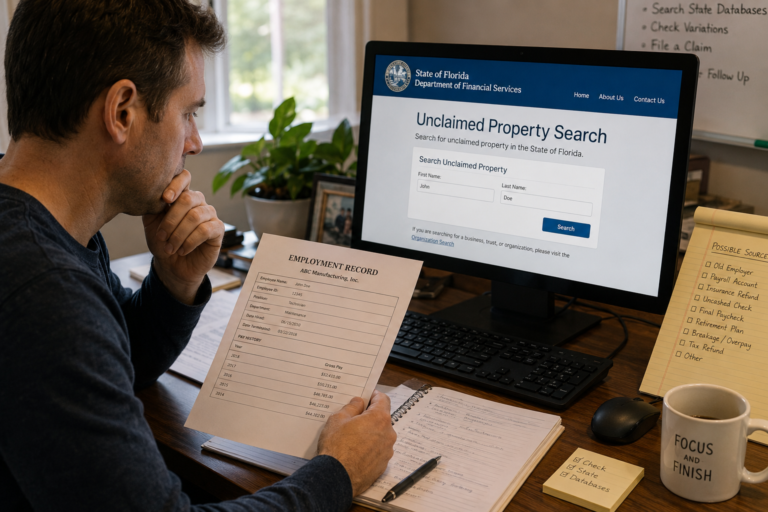
Understanding How Unclaimed Funds From Businesses End Up With the State
When businesses cannot successfully deliver money owed to someone, they are often legally required to turn those funds over to the state after a certain period of inactivity. This process is commonly called “escheatment,” although most consumers simply know it as unclaimed property reporting.
For example, a company may issue a paycheck that was never cashed, mail a refund check to an outdated address, or attempt to distribute retirement or payroll funds after an employee has moved away. If the business cannot contact the owner after the required holding period, the money is generally transferred to the state treasury or unclaimed property division.
This process applies even if the business later closes, declares bankruptcy, changes ownership, or merges with another company. Once the funds are transferred to the state, the original business may no longer control the property. Instead, the state becomes responsible for safeguarding the funds until the rightful owner files a claim.
Unclaimed money from closed businesses is not limited to former employees. Customers, contractors, investors, vendors, and beneficiaries may also have property connected to inactive companies. The type of funds involved often determines which documents are required during the claim process.
It is important to understand that official state programs are designed to reunite owners with their money. These programs are not investment opportunities, sweepstakes, or special government benefits. They simply hold abandoned financial property until someone proves ownership and requests its return.
For example, a company may issue a paycheck that was never cashed, mail a refund check to an outdated address, or attempt to distribute retirement or payroll funds after an employee has moved away. If the business cannot contact the owner after the required holding period, the money is generally transferred to the state treasury or unclaimed property division.
This process applies even if the business later closes, declares bankruptcy, changes ownership, or merges with another company. Once the funds are transferred to the state, the original business may no longer control the property. Instead, the state becomes responsible for safeguarding the funds until the rightful owner files a claim.
Unclaimed money from closed businesses is not limited to former employees. Customers, contractors, investors, vendors, and beneficiaries may also have property connected to inactive companies. The type of funds involved often determines which documents are required during the claim process.
It is important to understand that official state programs are designed to reunite owners with their money. These programs are not investment opportunities, sweepstakes, or special government benefits. They simply hold abandoned financial property until someone proves ownership and requests its return.
Common Situations That Lead to Unclaimed Money From Former Employers
People often discover unclaimed funds years after leaving a company. Sometimes the amounts are small, while other claims involve larger payroll balances, retirement distributions, or stock-related payments.
Several common situations can lead to unclaimed money connected to a closed business or employer:
Consider a realistic example. Someone worked for a regional retailer during college and moved shortly after graduation. Years later, the company filed for bankruptcy and closed locations across several states. During the closure process, payroll reconciliation identified an uncashed check tied to the former employee’s old address. Because the employee could not be reached, the funds were eventually transferred to the state’s unclaimed property office.
Another common example involves mergers and acquisitions. A business may change names multiple times over several decades. Former employees often search only under the final company name and miss records associated with older names or parent corporations. Searching variations of business names can sometimes uncover additional results.
Several common situations can lead to unclaimed money connected to a closed business or employer:
- An employee moved before receiving a final paycheck.
- A payroll check expired before it was deposited.
- A company closed during layoffs or restructuring.
- An employer-sponsored retirement distribution was never completed.
- A refund or reimbursement check was mailed to an old address.
- Stock dividends or shareholder payments went unclaimed after a merger.
- A deceased family member had unpaid wages or benefits tied to a former employer.
- A commission payment was issued to an outdated address.
Consider a realistic example. Someone worked for a regional retailer during college and moved shortly after graduation. Years later, the company filed for bankruptcy and closed locations across several states. During the closure process, payroll reconciliation identified an uncashed check tied to the former employee’s old address. Because the employee could not be reached, the funds were eventually transferred to the state’s unclaimed property office.
Another common example involves mergers and acquisitions. A business may change names multiple times over several decades. Former employees often search only under the final company name and miss records associated with older names or parent corporations. Searching variations of business names can sometimes uncover additional results.
Step-by-Step Instructions for Searching Official State Programs
Gather Old Employment or Business Information
Before starting a search, collect as much information as possible about the former employer or business relationship. Even partial details can help narrow results during a state search.
Helpful information may include:
Helpful information may include:
- Former business names
- Previous addresses
- Approximate years of employment
- Old pay stubs or tax forms
- W-2 or 1099 documents
- Name changes after marriage or divorce
- Prior mailing addresses connected to the employer
Search Official State Unclaimed Property Websites
Each state operates its own unclaimed property program. Searches are typically free and available online through the state treasury, comptroller, or revenue department.
Start by searching the state where the business operated or where you lived while working there. If the company operated in multiple states, it may be worth checking each relevant state individually.
Search using:
Start by searching the state where the business operated or where you lived while working there. If the company operated in multiple states, it may be worth checking each relevant state individually.
Search using:
- Your current legal name
- Previous names
- Common spelling variations
- Business names connected to your employment
Review Claim Details Carefully
Once you locate a possible match, review the details provided by the state. Some states display:
- The reporting business name
- The last known address
- The property type
- The amount range
- The date reported
Submit Documentation to Verify Ownership
After identifying a possible claim, the state typically requires documents proving identity and ownership before releasing funds.
Common documentation may include:
Common documentation may include:
- Government-issued photo identification
- Proof of Social Security number
- Old employment records
- W-2 forms
- Proof of address matching the record
- Legal name change documentation
Wait for State Processing
Claim review times vary significantly between states and claim types. Some straightforward claims process relatively quickly, while others involving older business records or estates may require additional verification.
States may contact you if additional documents are needed. Responding promptly can help prevent delays during processing.
States may contact you if additional documents are needed. Responding promptly can help prevent delays during processing.
How to Recognize Legitimate Unclaimed Property Programs
Official unclaimed property searches are free through state-run programs. You should never be required to pay an upfront fee simply to search your name in a government database.
Legitimate state programs generally operate through official government agencies such as:
Common warning signs include:
Another common scam involves fake emails asking for Social Security numbers, bank logins, or payment card information before any legitimate claim exists. Real state agencies typically allow you to search publicly first and only request documentation during the official verification process.
If you are unsure whether a communication is legitimate, visit the official state unclaimed property website directly rather than clicking links from unsolicited emails or text messages.
Legitimate state programs generally operate through official government agencies such as:
- State treasuries
- Comptroller offices
- Departments of revenue
- State financial administration offices
Common warning signs include:
- Requests for upfront payment before releasing funds
- Pressure to act immediately
- Requests for full banking information early in the process
- Emails pretending to be government agencies but using unofficial web addresses
- Phone calls demanding sensitive information before verification
Another common scam involves fake emails asking for Social Security numbers, bank logins, or payment card information before any legitimate claim exists. Real state agencies typically allow you to search publicly first and only request documentation during the official verification process.
If you are unsure whether a communication is legitimate, visit the official state unclaimed property website directly rather than clicking links from unsolicited emails or text messages.
How Long Claims From Closed Businesses Usually Take
Unclaimed property timelines vary based on both state laws and the complexity of the claim. Before funds even reach the state, businesses are usually required to hold dormant property for a specific period of time. This holding period often ranges from one to several years depending on the property type.
After funds are transferred to the state, processing timelines for claims can also vary. Simple claims involving straightforward identity verification may move faster than claims involving estates, old employment records, or disputed ownership.
Several factors commonly affect processing times:
It is important to remain patient during the process. States are responsible for verifying ownership carefully before releasing funds, especially when businesses are no longer operating and supporting records may be limited.
After funds are transferred to the state, processing timelines for claims can also vary. Simple claims involving straightforward identity verification may move faster than claims involving estates, old employment records, or disputed ownership.
Several factors commonly affect processing times:
- The age of the record
- The type of property involved
- Whether supporting documents are complete
- Name mismatches or address inconsistencies
- Estate or beneficiary verification requirements
- High claim volume within the state office
It is important to remain patient during the process. States are responsible for verifying ownership carefully before releasing funds, especially when businesses are no longer operating and supporting records may be limited.
Helpful Tips for Searching for Old Employer-Related Funds
Searching for unclaimed money tied to a former employer often requires patience and careful record matching. Small details can make a significant difference during the search process.
- Search every state where you previously lived or worked.
- Use previous addresses connected to old employers.
- Search maiden names, former married names, and spelling variations.
- Check for parent company names if the business merged or rebranded.
- Keep copies of W-2 forms, pay stubs, and tax documents whenever possible.
- Review records for deceased relatives who may have had unpaid wages or benefits.
- Double-check older payroll providers or retirement administrators tied to former employers.
- Respond quickly if a state requests additional verification documents.